Saturday, February 26, 2022

Quick Shots: Young Guns II


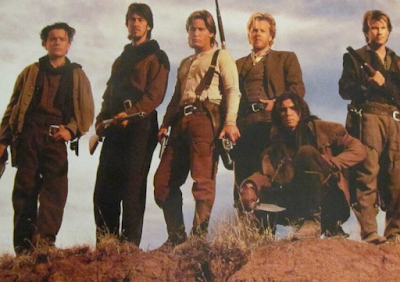
Young Guns II was one of my absolute favorite movies when I was a teen.  I saw both the first and second in the theater.  In retrospect, Young Guns is the superior film.  Better story, better character development, an overall much more grounded film, although it’s hard to see that through the lens of the Brat Pack cast.  For a 15 year old, Young Guns II was the way to go.  The movie is much closer to the Schwarzenegger / Stallone / Van Damme action films that filled out my weekends.  The shootouts are great, there’s a steady stream of one-liners, and Christian Slater’s take on “Arkansas” Dave Rudabaugh tips the cast of characters just over the line to over the top.  If Young Guns is trying to be a film, Young Guns II is comfortably a movie.

It was also the first time I ever fell in love with a saloon girl, saw a bare behind in a theater, and saw that a bunch of people might just get naked and drunk together for the sheer hell of it (as Pat Garrett recounts in the film).  Every time this movie ever ran on cable I’d hang along long enough to see this scene.


Wednesday, February 23, 2022

Introducing Lascivious Screengrabs

Somewhere around the start of the 2nd year of bullshit (I know the pandemic is just hitting year 2 right about now, but for me 2020 was a big steaming pile of cowpie right from the start, even before Covid) I started browsing web sites with screen grabs of movies.  I’d save them as I went, so that I would have a list of movies I’d watch when they inevitably landed on Tubi (the home of nearly every movie you’d ever want to watch).  As I saved screenshots on my kindle I would add labels so I knew where these shots came from.  Soon enough I had quite a collection of screenshots and, being who I am, a lot of them featured naked saloon girls.  It occurred to me that it would make a fun, if saucy, addition to Slap Bookleather if I accentuated commentary on movies with these screenshots.

So here we are, sporting a new tag of “lascivious screengrabs”, to add to the ramblings of an aging and world-weary cowpoke.  Below are several from movies on my to-watch list; you’ll see more from films I’ve seen in the weeks and months to come.


Monday, February 21, 2022

A long, long pause in Red Dead Redemption II


It’s getting on nearly a year since I last picked up Red Dead Redemption II for more than just a few minutes.  It’s not that I don’t like the game.  In fact it’s one of the greatest games I’ve ever played, and I think about it and the narrative all the time.  The problem is that I know where it’s going.  Arthur, that beastly rapscallion who grows a heart despite his thuggish past, was deep into decline with tuberculosis the last time that I played.  I’ve read enough about the game to know that, much like John Marsten in RDR, Arthur does not make it to the end of the game.  Maintaining the illusion of a vital Arthur so far is worth the delayed gratification of seeing the game through to the end.


Wednesday, February 16, 2022

Complaining About The Comancheros

Pandemic, death, cancer, inflation, political instability, people who won’t wear their stupid masks at the gym… of all the things happening in the world, you know what really ticks me off today?

The Comancheros, starring and ghost-directed by John Wayne.

It’s been nearly a year since I watched it and it till makes me mad for being a stupid piece of trash.  Here’s my biggest beeves with this crapfest:

  • The main character, Paul Regret, starts the story in 1843 New Orleans by killing a US Army officer in a duel over a woman.  He flees the country for the then-independent Republic of Texas. Despite his name, he never shows regret over the killing.  This is our hero.  
  • The main character, Paul Regret, starts the story in 1843 New Orleans by killing a US Army officer in a duel over a woman.  He flees the country for the then-independent Republic of Texas. Despite his name, he never shows regret over the killing.  This is our hero.
  • The movie goes on with a range of shootouts, Indian attacks, and double crossing.  The “Comanches” look like someone’s idea of northern plains Cheyenne from central casting, and their scenes are mostly just groups riding in formation at the camera with lots of disjointed yelling and shooting in the air.  If you’ve noticed the label “Outdated Cultural Reference” on movies lately, it’s because of nonsense like this.
  • By the end of the film, the entire body of Texas Rangers (led by Wayne) outright lies to United States authorities about Regret’s whereabouts and actions so he can avoid being held responsible for his actions.  Again, these are the heroes.

Why does this film still bother me, a year after I watched it?  Perhaps because it’s a little close to the “Ra! Ra! Truth, Justice, American Way! Law & Order! As long as it’s convenient and doesn’t conflict with my poorly defined sense of personal freedom!  January 6 was an FBI plot!  It was ANTIFA!  It was a peaceful protest!  F your feelings!  Own the libs!” attitude that my least favorite cable news promotes.

Qanon Shaman and Congressman Gaetz would fit right in with Wayne's Texas Rangers

(Before the flame begins, IMHO their competitor is almost as bad and I find John Stewart and Rush Limbaugh equally contemptable).

The Comancheros is also filled with a bewildering number of errors and anachronisms that a viewer with an even vague grasp of history and geography will note; the following list comes (with light editing) from the Internet Movie Database.

  • The shootouts use guns that are completely anachronistic; the guns used in the movie are Colt single action revolvers model 1873, Henry lever action rifle look-alikes model 1860, and Winchester lever action rifles model 1892. The only correct period guns used were the single-shot percussion-cap dueling pistols used in the opening scene
  •  John Wayne is shown wearing a Texas Ranger Badge. These badges were not introduced until the 1880s, 37 years after the year the movie story takes place (1843).
  • There is a reference of guns being stolen from Fort Sill and a character having served five years in Yuma Territorial Prison. As the film is supposedly set before 1848, neither is possible. Yuma Territorial Prison was opened in 1876, while Fort Sill was first established in 1869. Both occurred after Texas voted to become a state.
  • The movie takes place in 1843, but the song Red Wing (sung at various times throughout the movie) was not written until 1907.
  • The White cowboy characters wear vaquero-style cowboy boots which were not commonly worn by Americans until around the time of the Civil War. Anglos did not wear vaquero style clothing as that could have resulted in their being mistaken for Mexicans or even the eponymous Comancheros, the film's antagonists.
  • The majority of characters, including the lead actors, are shown to be clean-shaven which was rare at the time, especially outside of areas where clean water wasn't readily available. Additionally, most men wore at least a mustache, if not a full beard as it was the fashion at the time.
  • Several characters wear pants with belts running through the available belt loops even though this was not the custom until the 1920s at the earliest.
  • Paul Regret (Stuart Whitman) mentions to Melinda Marshall (Joan O'Brien} that he understands that her husband had been dead for four years. She answers that he was killed at the Battle of San Jacinto. The movie takes place in 1843 and the Battle of San Jacinto was fought in 1836, seven years earlier, not four.
  • Wayne’s character is supposedly taking Regret back to New Orleans, Louisiana from Galveston, Texas after they get off the paddle wheel steamboat. The land on that route along the Gulf coast of Texas and East Texas does not have mountains, buttes or mesas.
  • The Texas Rangers are presented like a squad that congregated around a headquarters and rode out like a posse. In fact, there were very few rangers and each was assigned a territory of thousands of square miles. Modern day rangers have offices in various locations around the state with a handful assigned to each office.
  • The central headquarters in Austin, as depicted, is in an arid location surrounded by mesas, sand and scrub. In fact, Austin is very green, filled with rivers and lakes, and has the same relative humidity as Honolulu, Hawaii.

Watch it for the scenes with Lee Marvin, though, he’s great.

Saturday, April 3, 2021

Quickshots- Glorious

Can you get excited about a novel that telegraphed it's big mystery around page three?

Sure you can!  Journalist Jeff Guinn's Glorious is a pretty good modern western novel.  Set in St. Louis and Arizona in the 1860s, it plays well with some of the historical oddities of the period like the Robber Barons, impromptu mining towns, prospector culture, and the start of the big cattle ranches.  As a change of pace the hero is no kind of gunslinger; he fires a gun a handful of times at the end of the novel, and is more likely to talk his way out of trouble.

Guinn's writing is fun, fast, and readable.  Glorious is the first of the Cash McLendon trilogy, with the next featuring buffalo hunting and the Battle of Adobe Wells.  As soon as I finished Glorious I read 50 pages of Buffalo Trail (#2) and started looking for Silver City (#3).  Guinn will probably not hit my list of all time favorites, but the books are worth the time. 

Saturday, March 27, 2021

Guns and Guts! A Better Than Expected Wild Bunch Ripoff

I may have found the perfect western- or at least the perfect guilty pleasure western.  Las Viboras Cambian de Peil, known in English as "Guns and Guts", is a 1974 Spaghetti western homage to Peckinpah's The Wild Bunch with a big slice of western decadence on the side.  Excepting that it was made in Mexico.  I swear I've seen the term "Tortilla Western" somewhere, but I'm not sure if that's a real expression or a "build the wall" douchebag style term.  Regardless, the film has a real Eurotrash feel to it, with a hero ("El Pistolero") looking a bit more like an Italian fashion model than a hardened gunslinger.  It works, because while El Pistolero makes his living with a gun, his real passion in life is prostitutes (just like his Mama!).  This sets the stage for a regular rotation of nude or scantily clad saloon girls and soiled doves making their way through the film.  The title could have been "Guns and Guts and Boobs".

Keep in mind that there are still plenty of both guns and guts.  Shootouts are frequent and increase in violence each time.  I get a sense that director Rene Cardona sat down with his visual effects guys and said "can you get me 50% of The Wild Bunch look on 10% of the budget?", and they did a decent job.  The blood tends to leak out of the squibs instead of splatter, and it's a little more orange than you would think, but it's effective.  The final gunfight is in some ways a direct rip off of the cataclysmic ending of The Wild Bunch.

What's that, you say?  What's the plot?  We don't need to stinking plot!  Just kidding.  It's a tough plot to explain, since the "hero" has by the end quadruple or quintuple crossed just about everyone in the film, setting up an assassination so he can retire to a found a personal brothel in Montana.  I think it was Montana, there were lots of breasts on the screen at the time and I think I lost track of the details.

It's that kind of movie. Don't sweat the details, just sit back and enjoy.  Currently found on Tubi, another good review found here.

PS- Google translate is stymied by the original Spanish title, it may be something like "The Serpent Sheds It's Skin".

Typical scene from the film


Friday, February 19, 2021

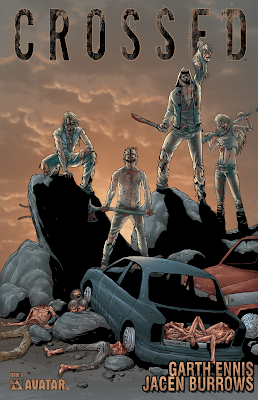
Crossed: Garth Ennis takes on Blood Meridian


In the middle of a resurging pandemic with a non-zero chance of a civil war in the next year, I decided to read Garth Ennis’ Crossed.  

Most people likely know Garth Ennis from the books he’s written that have gone on to be television series (Preacher on AMC and The Boys on Amazon).  Ennis’ big jump into comics was in fact with Preacher, way back in 1994, where he explicitly set out to write a western, but turned it on it’s side with the modern time period, metaphysical plot, crude humor, and general insanity.


Ennis’ work comes in two flavors- derivative nonsense (Streets of Glory) and pure genius (Saint of Killers).  Sometimes he manages to do both in the same book (Punisher: Born).  From the outside Crossed looks like something completely derivative, just being Ennis’ take on the ever popular Zombie Apocalypse.  Once I got a few issues in it became clear that just as Preacher is inspired by a broad brush of western tropes, Crossed is inspired by Cormac McCarthy’s Blood Meridian.


In this story an unknown event infects a mass of the population.  Rather than turning them to zombies, it strips away social constructs like morality, guilt, or conscience, leaving nothing but rage and depravity.  The infection leaves a cross-shaped rash on their faces; someone who is infected is referred to as having “crossed” over.  A group of survivors make their way through the wilderness to safety, dogged for hundreds of miles by a pack of Crossed.


There’s a point in the story where a group of Crossed makes an attack, and it immediately looked like the Indian attack that broke up Glanton’s gang in Blood Meridian: 


“A legion of horribles, hundreds in number, half naked or clad in costumes attic or biblical or wardrobed out of a fevered dream with the skins of animals and silk finery and pieces of uniform still tracked with the blood of prior owners, coats of slain dragoons, frogged and braided cavalry jackets, one in a stovepipe hat and one with an umbrella and one in white stockings and a bloodstained wedding veil and some in headgear or cranefeathers or rawhide helmets that bore the horns of bull or buffalo and one in a pigeontailed coat worn backwards and otherwise naked and one in the armor of a Spanish conquistador, the breastplate and pauldrons deeply dented with old blows of mace or sabre done in another country by men whose very bones were dust and many with their braids spliced up with the hair of other beasts until they trailed upon the ground and their horses' ears and tails worked with bits of brightly colored cloth and one whose horse's whole head was painted crimson red and all the horsemen's faces gaudy and grotesque with daubings like a company of mounted clowns, death hilarious, all howling in a barbarous tongue and riding down upon them like a horde from a hell more horrible yet than the brimstone land of Christian reckoning, screeching and yammering and clothed in smoke like those vaporous beings in regions beyond right knowing where the eye wanders and the lip jerks and drools.”


Ennis’ nine issue first story of Crossed is a horrible, hopeful, and brilliant western.  It'll break your heart.